




Best Tactical Gear for Extreme Athletes: 2026 Picks
Table of Contents
- Why Extreme Athletes Are Switching to Tactical Gear
- Quick Comparison: Top Tactical Gear Picks
- 1. Raider Slick Chest Rig: Low-Profile Load-Bearing
- 2. DOI Knee Sleeves: Joint Support for Heavy Lifts
- 3. No Time Duck Camo Hoodie: Mid-Layer Warmth
- 4. Knuckle Duster Shorts: Mobility for High-Intensity Training
- Benefits of Tactical Apparel for Athletes
- How to Layer Tactical Gear for Extreme Weather
- Frequently Asked Questions
Last Updated: September 4, 2026
Extreme athletes push their bodies past normal limits, yet most performance apparel fails when conditions turn brutal. That gap is why trail runners, mountaineers, and obstacle racers are abandoning traditional sportswear for tactical gear built to military specification. The best tactical gear combines the abrasion resistance and load-bearing capacity of field equipment with the breathability and range of motion required for high-intensity output. At Rogue American, we build gear tested in Austin, Texas, where 100-degree summers and unpredictable hill country weather demand apparel that performs across climates. This guide breaks down the top picks for 2026 and explains how to build a layering system that works when your training depends on it.
Tactical apparel is purpose-built clothing designed originally for military and law enforcement use, characterized by reinforced stitching, durable fabrics, and functional load-bearing features. Unlike standard athletic wear, it prioritizes resilience and mission-readiness without sacrificing mobility.
Why Extreme Athletes Are Switching to Tactical Gear
The standard athletic wear market optimizes for comfort in controlled environments, leaving athletes exposed when conditions turn extreme. Tactical gear closes that gap using materials and construction proven in combat zones where failure is not an option. The shift comes down to three advantages: durability, thermal regulation, and load-bearing design.
Most trail runners accept that a $150 jacket will delaminate after one season of bushwhacking (runrepeat.com). Tactical shell jackets use ripstop fabric and reinforced seams that survive years of abrasion against rock, brush, and ice. For athletes in remote terrain, this is the difference between finishing and turning back.
The second advantage is climate adaptation. Tactical layering systems were designed for operators who transition from freezing alpine passes to desert floors within hours, serving athletes who face temperature swings across a single training day. The third is practical load carriage: chest rigs and pockets built for ammunition and radios adapt naturally to nutrition, hydration, and emergency gear.
Army Combat Readiness Center guidance on physical conditioning notes that service members who train in full kit develop greater endurance and joint stability than those who train without load. That principle transfers directly to civilian athletes seeking functional strength beyond the gym floor.
Quick Comparison: Top Tactical Gear Picks
| Product | Price | Best For | Key Feature |
|---|---|---|---|
| Raider Slick Chest Rig | $99.99 | Load carriage, low-profile carry | Concealable under jacket, 4 magazine pouches |
| DOI Knee Sleeves | $49.99 | Heavy lifts, joint support | 7mm neoprene compression |
| No Time Duck Camo Hoodie | $69.99 | Mid-layer warmth, field wear | Heavyweight fleece, duck camo print |
| Knuckle Duster Shorts | $39.99 | High-intensity training, hot weather | 4-way stretch, quick-dry fabric |
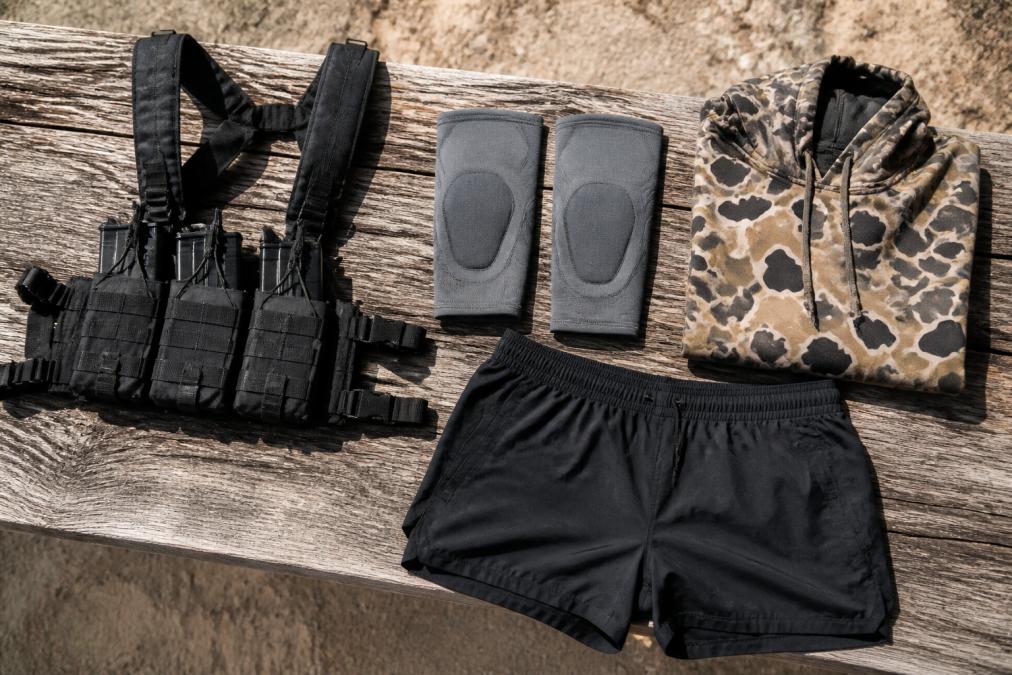
These four pieces form the core of a versatile tactical kit, each filling a specific role from load-bearing to joint protection to temperature management. Below we examine each in detail.

1. Raider Slick Chest Rig: Low-Profile Load-Bearing
The Raider Slick Chest Rig is the most versatile load-bearing platform we offer for athletes who train with weight or need hands-free carry. Priced at $99.99, it is manufactured in the USA as an ultra low-profile system that fits unnoticed under a light jacket or sweatshirt.
The rig holds 2x elastic 5.56x45mm rifle magazine pouches plus 2x pistol magazine pouches with retention fitted for active movement. AK 7.62x39mm magazines also fit, though locking tabs may cause premature wear. A hook panel backing attaches to a loop velcro plate carrier, while the included loop cover panel protects the rig when worn standalone.
For extreme athletes, the value extends beyond ammunition carry. Vertical and side webbing loops accept slotted buckles for integration with an H-harness or plate carrier, allowing configuration for navigation tools, hydration bladders, or weighted training loads. The low-profile design keeps everything tight to your body, preventing bounce and shift that ruins a run or climb.
2. DOI Knee Sleeves: Joint Support for Heavy Lifts
DOI Knee Sleeves provide the compression and warmth your knees need for heavy squats, lunges, and loaded carries. At $49.99, these 7mm neoprene sleeves deliver the support profile favored by powerlifters while remaining flexible enough for dynamic athletic movement.

The 7mm thickness offers significant joint stability without restricting range of motion. Neoprene traps body heat, increasing blood flow to the knee joint and improving proprioception during heavy sets. This warmth is critical for athletes training in cold environments where stiff joints are more prone to injury.
These sleeves also serve a recovery function. Wearing them during cool-down walks or light session work maintains joint temperature and reduces stiffness following high-volume leg days. For tactical athletes combining lifting with rucking or running, this support translates directly to injury prevention over long training blocks.
3. No Time Duck Camo Hoodie: Mid-Layer Warmth
The No Time Duck Camo Hoodie delivers the thermal regulation extreme athletes need between base layer and shell jacket. Priced at $69.99, it is built from premium heavyweight fleece that traps body heat while allowing moisture vapor to escape during high-output efforts.
Duck camo print provides a field aesthetic that transitions from trail to town without screaming tactical. The kangaroo pocket offers hands-free storage for gloves or nutrition, while ribbed cuffs and hem lock in warmth and prevent riding up during movement. This is the layer you reach for when temperatures hover near freezing and you need insulation without bulk.
What separates this hoodie from standard athletic fleece is fabric weight. Heavyweight fleece resists wind penetration better than lightweight alternatives, which matters when moving between shaded valleys and exposed ridgelines. It also handles abrasion from pack straps and brush better than softer, fashion-oriented hoodies.
4. Knuckle Duster Shorts: Mobility for High-Intensity Training
Knuckle Duster Shorts are built for athletes who train hard in hot conditions and refuse to sacrifice mobility for durability. At $39.99, they use a 4-way stretch fabric blend of 94% polyester and 6% spandex that moves through full range of motion without restriction.

The quick-drying construction manages sweat during high-intensity intervals, while the elastic waistband with drawstrings secures the fit through burpees, box jumps, and sprint work. Four pockets carry essentials without the bulk of cargo-style alternatives. The bold graphic print reinforces the mindset that drives disciplined training.
Tactical clothing for high-intensity training requires fabric that survives friction against battle ropes, climbing walls, and gym flooring. The polyester-spandex blend resists pilling and maintains stretch through repeated wash cycles, addressing the common complaint that athletic shorts lose their shape within months.
Benefits of Tactical Apparel for Athletes
The advantages of tactical apparel go beyond simple durability into measurable performance engineering. While standard athletic wear optimizes for a narrow comfort window, tactical gear is designed for a wider operational envelope. Understanding the specific mechanisms behind these benefits helps you make informed choices rather than following marketing trends.
- Temperature control: Layered tactical systems regulate heat across a wider temperature range than single-layer athletic wear, but the real advantage is the weight-to-warmth ratio. For an endurance athlete, every ounce matters. A typical civilian softshell jacket weighs 18-24 ounces (sectionhiker.com). A comparable tactical insulating layer, such as one using PrimaLoft Gold insulation with a 40-denier ripstop shell, can weigh as little as 12-14 ounces while providing equivalent warmth. This difference translates directly to less energy expended on every climb and descent. When you are moving for 8+ hours, shaving 8 ounces off your torso can reduce perceived exertion significantly over the course of a 20-mile day.
- Abrasion resistance: Reinforced fabrics survive contact with rock, ice, and equipment that destroys standard sportswear. The mechanism is in the weave. Tactical fabrics like 500-denier Cordura nylon use a high-tenacity yarn that resists tearing, while ripstop grids interrupt tear propagation. Standard athletic polyester knits, by contrast, have no such failsafe. A single snag on a sharp rock can create a run that widens over time.
- Load-bearing capacity: Pockets and attachment points carry training load without shifting or chafing. The key is the placement of the load relative to your center of mass. A well-designed chest rig or vest keeps weight high and close to your torso, minimizing the pendulum effect that occurs with a backpack. This is the same principle behind modern running vests used in ultramarathons.
- Weatherproofing: Water-resistant and wind-resistant shells maintain protection through sudden condition changes. The critical metric here is not just waterproof rating (measured in millimeters) but moisture vapor transmission rate (MVTR), measured in grams per square meter per per 24 hours. A high-end athletic shell might have an MVTR of 25,000g. A tactical shell designed for high-output activity should match that, but many budget options fall short at 10,000-15,000g, leading to internal condensation and a clammy feeling during high-output efforts.
The most significant benefit is integration with non-tactical athletic gear. Most guides treat tactical and civilian performance gear as separate worlds, but extreme athletes rarely operate that way. A trail runner might pair a tactical chest rig with a civilian merino base layer. A mountaineer might use tactical knee sleeves under softshell climbing pants. Compatibility hinges on attachment standards and layer thickness. Look for gear using standard 1-inch webbing or hook-and-loop platforms, which allow attaching civilian hydration bladders or nutrition pouches. Also consider the bulk profile: a chest rig adding 2 inches of thickness will not fit under a trim civilian running jacket. The best systems use low-profile materials like laser-cut laminate or thin elastic webbing, integrating seamlessly without creating hot spots or restricting movement.
Sustainability is also becoming a differentiator. Traditional military-spec fabrics rely heavily on virgin nylon and PFAS-based DWR treatments. However, a new wave of manufacturers produces tactical-grade gear using recycled nylon (often from fishing nets or post-industrial waste) and C0 DWR treatments that avoid fluorocarbons. These materials do not compromise on abrasion resistance or water shedding but reduce environmental footprint. For athletes who spend time in wild places, this matters. When choosing between two otherwise equal pieces of gear, opting for one with recycled content certification or bluesign-approved fabric is a concrete way to reduce impact without sacrificing performance.
How to Layer Tactical Gear for Extreme Weather
Mastering how to layer tactical gear for extreme weather separates athletes who train year-round from those who retreat indoors. The three-layer system used by military forces adapts perfectly to extreme sports, but execution requires understanding specific materials and their failure modes. The system is only as strong as its weakest layer, and a single cotton garment in the wrong place can compromise the entire system.
Base layer: Start with a moisture-wicking synthetic or merino base layer against your skin. This pulls sweat away from your body, preventing the chilling effect that occurs when moisture evaporates in cold air. The key metric is fabric weight and knit structure. For high-output activities in sub-freezing conditions, a 150-200 g/m² merino or a 100% polypropylene grid-fleece base layer is optimal. Grid-fleece, with its waffle-like texture, creates channels for moisture to move away from the skin while trapping dead air for insulation. Avoid cotton at all costs; it absorbs up to 25 times its weight in water, collapses when wet, and accelerates heat loss.
Mid-layer: Add the No Time Duck Camo Hoodie or equivalent polyester fleece insulation. This layer traps warm air close to your body while allowing moisture vapor to pass through. The critical factor here is air permeability versus wind resistance. A high-loft fleece with a loose knit is excellent for static insulation but fails during high-output descents where wind can strip away the trapped warm air. Look for a mid-layer with a tighter weave or a wind-resistant membrane on the front panel only. This is a common design in tactical garments because it protects the core without trapping heat on the back where you need ventilation. Adjust this layer based on activity intensity: remove it during high-output climbs, add it during descents or rest periods.
Shell layer: Finish with a water-resistant, wind-resistant shell jacket that blocks precipitation while maintaining breathability. The shell should fit loosely enough to accommodate the layers beneath without restricting movement or compressing insulation. The choice of shell depends on the specific environment. In wet, above-freezing conditions (40-50°F), prioritize a waterproof breathable membrane like Gore-Tex Pro or eVent, which offer high MVTR (25,000+ g/m²/24hr) but are heavier. In cold, dry conditions (below 20°F), a softshell with a DWR finish is often superior because it breathes better during high output and sheds light snow effectively. The trade-off is that a softshell will wet out in sustained rain.
Climate adaptation requires adjusting this system based on conditions. For cold-weather training, prioritize synthetic insulation that retains warmth when wet; down loses its loft and insulating value when wet, making it a poor choice for high-sweat activities. For wet environments, focus on the shell's waterproof rating over breathability. For mixed conditions, choose modular layers you can add or remove without stopping your session.
A unique angle most guides miss is field maintenance and repair. When you are 15 miles from the trailhead and your shell tears on a rock, your options are limited. The best tactical gear is designed for field repair. Look for shells that come with a small patch kit, or carry your own. A 2-inch piece of tenacious tape (a polyurethane repair tape) can seal a tear in a shell or sleeping bag. For base layers and fleece, a simple needle and thread can close a seam. For more serious damage to a waterproof membrane, a patch of gear aid seam grip can re-seal a seam that has pulled apart. The key is to practice these repairs before you need them. Most practitioners find that a 10-minute field repair can extend the life of a high-end garment by years, saving hundreds of dollars and preventing a mission-ending failure.
:::takeaway The best tactical gear for extreme athletes is a system, not a single product. Build a complete layering system with moisture-wicking base layers, insulating mid-layers, and a weatherproof shell, then add load-bearing and joint support pieces based on your specific sport. Prioritize weight-to-warmth ratio over absolute warmth, and always carry a small field repair kit to handle unexpected damage.
Frequently Asked Questions
What tactical gear do Navy SEALs use?
Navy SEALs use gear selected for mission-specific needs, often from brands that prioritize durability and low weight. Common items include plate carriers, chest rigs, moisture-wicking base layers, and ripstop outerwear. The Raider Slick Chest Rig reflects this design philosophy with its low-profile build and elastic magazine pouches. For extreme athletes, the focus is on gear that stays secure during movement without adding bulk.
Why is tactical apparel better for extreme sports than standard gym wear?
Tactical apparel is built for durability and function. It uses ripstop fabric, reinforced stitching, and materials that handle abrasion better than typical gym wear. For extreme athletes, this means gear that survives repeated use in harsh conditions. Tactical clothing also prioritizes load-bearing features and pocket placement, which standard athletic wear often lacks.
How should I layer tactical gear for extreme weather?
Start with a moisture-wicking base layer to pull sweat off your skin. Add a mid-layer like the No Time Duck Camo Hoodie for insulation. Finish with a water-resistant and wind-resistant shell jacket to block the elements. This system lets you adjust as your intensity changes. During high-output movement, shed the mid-layer to prevent overheating.
What should I look for in tactical clothing for high-intensity training?
Look for fabrics with 4-way stretch and quick-drying properties. The Knuckle Duster Shorts use 94% polyester and 6% spandex, which allows full range of motion during squats or sprints. Check for secure pockets that won't let essentials fall out mid-workout. Reinforced stitching at stress points prevents blowouts during heavy use.
Is tactical gear worth the higher price compared to standard athletic wear?
The price difference reflects materials and construction. Tactical gear uses heavier fabrics, reinforced seams, and hardware designed for field conditions. A $39.99 pair of tactical shorts will outlast several cheaper pairs of gym shorts. For athletes who train daily in tough environments, the cost per use is often lower than replacing standard gear frequently.