



Tactical Clothing vs Standard Gym Wear: 2026 Guide
Table of Contents
- Tactical Clothing vs Standard Gym Wear: Quick Comparison
- Material Composition and Durability: Why Tactical Gear Lasts Longer
- Range of Motion and Ergonomic Design for Functional Fitness
- Breathability and Moisture-Wicking: Tactical vs Gym Performance
- Benefits of Tactical Clothing for Training and Daily Carry
- Best Workout Gear for Tactical Athletes: What to Look For
- Care and Maintenance: Making Tactical Apparel Last
- Conclusion
- Frequently Asked Questions
Last Updated: September 15, 2026
Tactical Clothing vs Standard Gym Wear: Quick Comparison
Tactical clothing is built from heavier, abrasion-resistant fabrics with reinforced stitching and utility pockets, while standard gym wear prioritizes lightweight stretch and moisture-wicking comfort for controlled indoor training. This guide from Rogue American breaks down where each category wins, and where the tactical side earns its higher price.
The core difference comes down to mission. Gym wear is engineered for a climate-controlled hour on rubber flooring. Tactical clothing is engineered for the range, the field, the duty belt, and the twelve-hour shift that follows. That single design gap shapes everything: fabric weight, seam placement, pocket layout, and how the garment holds up after a hundred wash cycles.
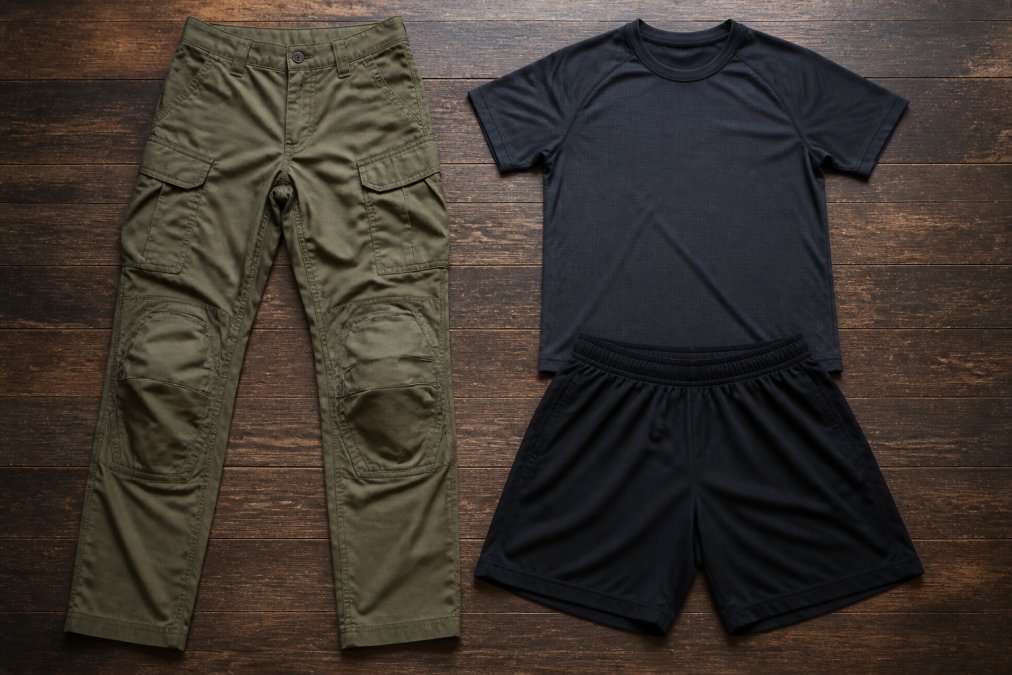
Here is the short version before we get into the details:
| Factor | Tactical Clothing | Standard Gym Wear |
|---|---|---|
| Primary fabric | Ripstop nylon, heavy cotton blends | Polyester, spandex, elastane |
| Durability | High, reinforced at stress points | Moderate, wears at seams |
| Range of motion | Articulated knees, gusseted crotch | Four-way stretch |
| Breathability | Moderate, improving each year | Excellent |
| Utility | Load-bearing pockets, loops | Minimal, if any |
| Best for | Field, range, daily carry | Gym floor, studio classes |
Material Composition and Durability: Why Tactical Gear Lasts Longer
Durability is where tactical clothing separates itself fastest, and the reason is textile engineering, not marketing. The three fabrics you will see most often are ripstop nylon, cotton-poly blends, and stretch-woven nylon with elastane. Each solves a different problem.
Ripstop is a plain-weave fabric with a grid of thicker reinforcement threads woven in at intervals, usually every few millimeters. That grid is what stops a tear from running: when the fabric is punctured, the heavier threads in the grid act as a rip barrier, which is why ripstop fails in small holes rather than long tears. Ripstop is typically measured in denier, the weight in grams of 9,000 meters of the fiber (astm.org). A 30D ripstop is light and packable; a 70D to 100D ripstop is what you find in hard-use tactical pants. Higher denier means more abrasion resistance and more weight.
Cotton-poly blends trade some of that tear resistance for comfort and a lower sheen. A 65/35 poly-cotton blend holds its shape better than pure cotton, resists shrinking, and takes dye well, which is why it dominates uniform-style tactical pants. The trade-off is dry time: cotton holds water, so a soaked poly-cotton pant can take hours to dry, while a nylon ripstop pant with a durable water repellent (DWR) finish sheds most of it and dries in a fraction of the time.
Stretch-woven nylon with a small percentage of elastane (often 4 to 12 percent) is the newest category and the one most directly competing with gym wear. It gives you the abrasion resistance of nylon with enough mechanical stretch to squat and climb without a gusset doing all the work. The catch is that elastane degrades with heat and chlorine, so these fabrics demand gentler laundering than a cotton blend.
Reinforcement is the second half of the durability story. Look for bar-tacks at pocket corners, double- or triple-stitched seams at the seat and knees, and sometimes a second layer of fabric at the knee or the inner thigh. A common mistake is assuming "tactical" means "indestructible." It does not. It means the failure points have been moved. Reinforced stitching at high-wear zones means the fabric wears out before the seams do, which is the opposite of how most activewear fails.
What most guides miss is the weight trade-off, and it is the same trade-off that shows up in biomechanics. Heavier fabric resists abrasion and holds its shape, but it holds heat too, and the extra mass changes how you move. A pair of tactical pants can weigh noticeably more than a pair of training shorts, and that added weight sits low on the hips and thighs. In explosive movements, box jumps, kettlebell swings, broad jumps, that mass has to be accelerated and decelerated with every rep. Most practitioners find that a heavy pant is fine for strength work and rucking but adds fatigue during plyometrics and sprint intervals. If your training is 45 minutes of high-intensity interval training in a climate-controlled gym, that weight is dead cost. If you are crawling, kneeling, or carrying a load, it is the whole point.
Range of Motion and Ergonomic Design for Functional Fitness
Ergonomic design in tactical clothing is not marketing language. Articulated knees, gusseted crotches, and stretch panels behind the knee exist because a squared-off pattern binds the moment you squat, climb, or go prone. Standard gym wear solves the same problem differently, through four-way stretch fabric rather than cut.
Both approaches work. The difference shows up in how the garment ages. Stretch fabric relaxes over time and loses some of its snap. A well-patterned tactical pant keeps its geometry because the shape, not the elasticity, is doing the work.
For functional fitness, this matters most in movements that combine load and range: front squats, kettlebell swings, box jumps, and anything involving a ruck. Try this test in the fitting room: squat to depth, then reach overhead. If the waistband digs or the knees pull, the pattern is wrong for you regardless of the brand.
Breathability and Moisture-Wicking: Tactical vs Gym Performance
Standard gym wear wins on breathability, and it is not close, but the reason is more specific than "it's lighter." Breathability is a function of knit structure and air permeability, not just fabric weight. Gym apparel is usually a jersey knit or a mesh with an open structure that lets air pass through the fabric itself. Tactical apparel is usually a woven fabric, and woven fabrics are inherently less air-permeable because the yarns interlock tightly. That tight weave is what gives tactical fabric its abrasion resistance, so the two properties are in direct tension.
Moisture management is a separate mechanism. Wicking fabrics move liquid sweat along the fiber surface to the outer face of the garment, where it can evaporate. Polyester and nylon are naturally hydrophobic, so they wick well but feel clammy if the fabric can't dry. Cotton is hydrophilic, it absorbs sweat and holds it, which is why a cotton t-shirt gets heavy and stays wet.
How moisture-wicking fabrics move sweat
Benefits of Tactical Clothing for Training and Daily Carry
Best Workout Gear for Tactical Athletes: What to Look For
Use this checklist before you buy:
Care and Maintenance: Making Tactical Apparel Last
Conclusion
Frequently Asked Questions
Is it acceptable to wear tactical clothing to a commercial gym?
Yes, tactical clothing works fine at most commercial gyms. The athletic fit and stretch fabrics allow full range of motion for lifting and cardio. Many tactical pants and shorts look similar to standard training apparel, so they blend in. Just avoid anything with excessive MOLLE webbing or visible utility pouches if your gym has a strict dress code. Focus on low-profile pieces like the Boogieman Shirt or Rhodesian Silkies that prioritize performance without drawing unwanted attention.
What are the functional differences between tactical pants and gym shorts?
Tactical pants typically use ripstop nylon or cotton blends with articulated knees, gusseted crotches, and reinforced stitching for abrasion resistance. Gym shorts prioritize lightweight stretch and moisture-wicking but often lack load-bearing capacity. Tactical pants handle utility pockets, knife clips, and belt loops for daily carry. Gym shorts excel at breathability during high-intensity interval training. Your choice depends on whether you need durability and utility or pure ventilation and freedom of movement.
Does tactical clothing provide better durability for high-intensity training?
Generally, yes. Tactical apparel uses heavier fabrics like 60/40 poly-cotton tri-blends and ripstop weaves that resist tearing and abrasion. Reinforced stitching at stress points, such as shoulders and crotches, extends lifespan. Standard gym wear often uses thinner synthetic fibers that pill or lose shape after repeated washing. If you train hard five or more days per week, tactical pieces like the Death Dealers Ace of Spades Shirt hold up longer. The trade-off is slightly higher weight and price.
Are tactical shirts breathable enough for cardio workouts?
Modern tactical shirts have closed the breathability gap. Many use moisture-wicking polyester blends that pull sweat away from skin and dry quickly. The Boogieman Shirt, for example, uses a lightweight poly-cotton tri-blend that breathes well during moderate cardio. For extreme endurance sessions, standard gym wear still edges ahead with lighter mesh panels. But for tactical athletes doing functional fitness, rucking, or interval training, today's tactical shirts handle sweat management effectively without sacrificing durability.
How does the fit of tactical gear differ from athletic compression wear?
Tactical gear uses an athletic fit that sits close to the body without squeezing. It allows layering under uniforms or outerwear. Athletic compression wear is designed to be skin-tight for muscle support and blood flow. Tactical pants feature articulated knees and gusseted crotches for squatting and climbing. Compression wear restricts movement in those positions. If you need freedom for functional fitness or daily carry, choose tactical. If you want muscle recovery and reduced soreness, compression wear wins.